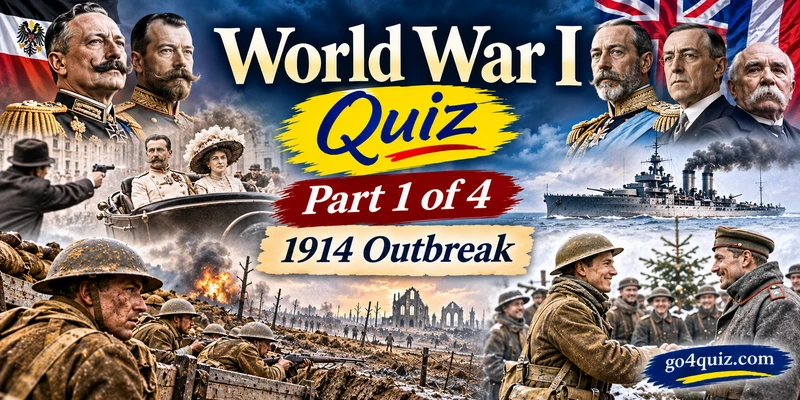
World War I began in the summer of 1914 after decades of imperial rivalry, naval arms races, and tangled European alliances turned a regional Balkan crisis into a global war. Part 1 of our chronological World War I quiz series explores the roots of the conflict, the assassination of Archduke Franz Ferdinand in Sarajevo on June 28, 1914, the rapid chain of mobilizations and declarations of war, the opening battles on the Western and Eastern fronts, the halt of the German advance at the First Battle of the Marne, the decisive German victory at Tannenberg, the war at sea, and the famous Christmas Truce of 1914. Test your grasp of the pivotal events and figures that launched the First World War.
World War I Quiz - Part 1 (Pre-1914 to Late 1914)
0 of 0 answered
1. Which two major European alliance blocs faced off in the years immediately preceding World War I?
Britain, France, and Russia formed the Triple Entente, while Germany, Austria-Hungary, and Italy were linked through the Triple Alliance (though Italy initially stayed neutral in 1914 before joining the Allies in 1915).
2. Which region of southeastern Europe was known as the 'powder keg of Europe' due to rising nationalism and rival imperial ambitions before 1914?
Following the Balkan Wars of 1912 and 1913, tensions between Austria-Hungary, Serbia, and the Ottoman Empire set the stage for the crisis of summer 1914.
3. When was Archduke Ferdinand assassinated?
On June 28, 1914, Archduke Franz Ferdinand, heir presumptive to the Austro-Hungarian throne, and his wife Sophie were assassinated in Sarajevo, Bosnia.
4. Who assassinated Archduke Franz Ferdinand and his wife Sophie in Sarajevo on June 28, 1914?
A 19-year-old Bosnian Serb nationalist member of the Young Bosnia group linked to the Black Hand, Gavrilo Princip shot Franz Ferdinand after a failed grenade attack earlier that morning.
5. Which country issued a harsh ultimatum to Serbia on July 23, 1914, and declared war on July 28, 1914, sparking the July Crisis?
Backed by Germany's 'blank check' pledge of support, Austria-Hungary declared war on Serbia on July 28, 1914, one month after the Sarajevo assassination.
6. Which major European power ordered general mobilization in late July 1914 to defend Serbia, prompting Germany to declare war on August 1, 1914?
Tsar Nicholas II's mobilization to protect fellow Slavs in Serbia triggered German declarations of war against Russia on August 1 and against France on August 3, 1914.
7. Which German operational war plan aimed to defeat France swiftly by sweeping through neutral Belgium before turning east against Russia?
Originally drafted under Alfred von Schlieffen and modified by Helmuth von Moltke the Younger, the plan violated Belgian neutrality and drew Great Britain into the war.
8. Which neutral country did Germany invade on August 4, 1914, prompting Great Britain to declare war on Germany later that day?
Honoring the 1839 Treaty of London guaranteeing Belgian neutrality, Britain declared war on Germany on August 4, 1914, after Germany rejected an ultimatum to withdraw.
9. Which Pacific nation entered World War I on the Allied side in August 1914 under the Anglo-Japanese Alliance and seized German territories in China and the Pacific?
Declaring war on Germany on August 23, 1914, Japan captured the German leasehold at Qingdao (Tsingtao) in China and occupied German island groups in Micronesia.
10. Which early August 1914 Belgian border fortress held out for nearly two weeks against heavy German siege artillery, slowing the initial German advance?
Although German forces captured Liege by mid-August 1914 using giant siege howitzers like 'Big Bertha,' Belgian resistance bought valuable time for French and British troops.
11. Which French commander-in-chief halted the German advance toward Paris in the First Battle of the Marne in September 1914?
Fought from September 6 to 12, 1914, the First Battle of the Marne checked the German push on Paris and marked the end of rapid open maneuver warfare on the Western Front.
12. What famous makeshift transport fleet helped rush French reinforcement troops toward the front lines during the First Battle of the Marne in September 1914?
Around 600 Renault AG1 Paris taxis transported roughly 4,000 to 6,000 French soldiers toward Nanteuil-le-Haudouin, becoming an enduring symbol of national resolve.
13. Following the stalemate after the First Battle of the Marne, what name was given to the autumn 1914 series of flanking maneuvers extending trench lines to the North Sea coast?
From September to November 1914, Allied and German forces repeatedly tried to outflank one another northward until continuous fortified trenches stretched from Switzerland to the Belgian coast.
14. Who led Germany to victory over Russia at Tannenberg in 1914?
Fought in late August 1914 in East Prussia, German Eighth Army forces under Paul von Hindenburg and Erich Ludendorff encircled and virtually destroyed the Russian Second Army at Tannenberg.
15. Which Russian general commanded the Russian Second Army that suffered devastating losses at the Battle of Tannenberg in August 1914?
Overwhelmed after advancing rapidly into East Prussia while communications faltered between Russian armies, General Alexander Samsonov took his own life following the defeat at Tannenberg.
16. Which October-November 1914 battle in western Belgium saw fierce clashes around a historic Flemish town and left British and German armies locked in grueling trench warfare?
Fought from October 19 to November 22, 1914, the First Battle of Ypres ended major mobile operations on the Western Front for the winter and inflicted severe losses on the original British Expeditionary Force.
17. Which famous November 1914 naval clash off the coast of Chile resulted in a German cruiser squadron defeating a smaller British squadron?
On November 1, 1914, German Vice Admiral Maximilian von Spee's East Asia Squadron sank two British armored cruisers off Coronel before being defeated at the Falkland Islands in December 1914.
18. Which December 1914 British naval victory in the South Atlantic destroyed Admiral Maximilian von Spee's German cruiser squadron?
On December 8, 1914, a British battlecruiser squadron under Vice Admiral Doveton Sturdee intercepted and sank four of Spee's five cruisers near the Falkland Islands.
19. Which Ottoman leader signed a secret alliance with Germany on August 2, 1914, and brought the Ottoman Empire into the war on the Central Powers' side in late October 1914?
Following Ottoman naval bombardment of Russian Black Sea ports in late October 1914, Britain, France, and Russia declared war on the Ottoman Empire in early November 1914.
20. Which two German warships—SMS Goeben and SMS Breslau—escaped Mediterranean pursuit in August 1914 and reached Constantinople, helping draw the Ottoman Empire into the war?
Transferred nominally to the Ottoman navy as Yavuz Sultan Selim and Midilli, the ships helped tilt Ottoman leadership toward intervention alongside the Central Powers.
21. What was the name of the famous unofficial ceasefire along parts of the Western Front in late December 1914 where soldiers exchanged greetings, gifts, and football matches?
Occurring spontaneously in several sectors between British and German troops around December 24 and 25, 1914, the Christmas Truce became one of the most memorable human episodes of World War I.
22. Which British naval blockade tactic begun in 1914 restricted food, raw materials, and supplies reaching Germany and the Central Powers?
Enforced by the Grand Fleet across the North Sea and English Channel, the blockade caused severe food and supply shortages in Germany over the course of the war.
23. Which small German light cruiser operated independently across the Indian Ocean in late 1914, raiding Allied merchant shipping and bombarding Madras before being sunk at Cocos Islands?
Commanded by Captain Karl von Muller, SMS Emden captured or sank dozens of merchant vessels and shelled oil tanks at Madras in September 1914 before HMAS Sydney destroyed it on November 9, 1914.
24. Which British field marshal commanded the British Expeditionary Force (BEF) in France during the opening campaigns of 1914?
Leading the BEF from its deployment to France in August 1914 through the retreat from Mons, the Marne, and First Ypres, Sir John French commanded the force until succeeded by Douglas Haig in December 1915.
25. Which British Secretary of State for War launched a massive volunteer recruitment campaign in Britain in 1914 featuring his famous pointing-finger poster?
Appointed in August 1914 as a national figurehead, Field Marshal Lord Kitchener appealed for 'Kitchener's Army' of volunteer recruits before conscription was introduced in 1916.