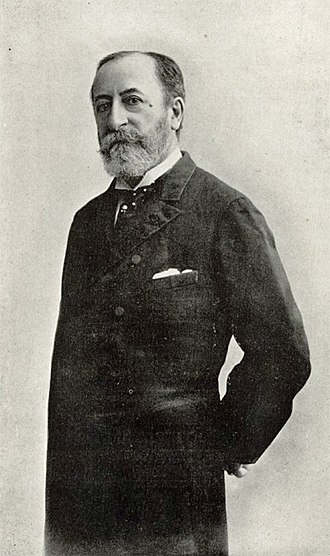
Explore the life, Parisian organ mastery, orchestral wit, and wide-ranging repertoire of composer Camille Saint-Saens with this 25-question quiz. The opening questions cover his birth in Paris in 1835, early childhood loss of his father, prodigy concert debut, studies at the Paris Conservatoire, and organist posts at Saint-Merri and La Madeleine. Subsequent items examine his teaching at the Ecole Niedermeyer with pupil Gabriel Faure, co-founding the Societe Nationale de Musique, La princesse jaune, Samson et Dalila, and his tours to the United States. You will also find questions on his three numbered symphonies, Symphony No. 3 (“Organ”), The Carnival of the Animals, Danse macabre, and his five piano concertos. Designed for classical music lovers, students, and trivia enthusiasts, this quiz helps you review key facts quickly and test your recall across Saint-Saens’s career. Attempt all 25 questions below to check your score and reinforce your music history knowledge.
Camille Saint-Saens Biography and Music Quiz
0 of 0 answered
1. In what year was Camille Saint-Saens born?
Camille Saint-Saens was born in Paris on October 9, 1835 and died in Algiers on December 16, 1921.
2. Where was Camille Saint-Saens born?
Saint-Saens was born in Paris in 1835 and remained closely tied to French musical life throughout his long career.
3. How soon after Camille Saint-Saens' birth did his father pass away?
His father died when Camille was an infant, leaving him to be raised by his mother and great-aunt Charlotte Masson.
4. At what age did Camille Saint-Saens make his official concert debut as a child prodigy?
Saint-Saens made his celebrated public concert debut in Paris at age ten.
5. Which composer's piano concerto did the ten-year-old Camille Saint-Saens perform at his debut?
Young Saint-Saens played Mozart's Piano Concerto in B-flat major, K. 450 alongside solo pieces at his Paris debut.
6. Who was Camille Saint-Saens' primary organ teacher at the Paris Conservatoire?
Francois Benoist instructed Saint-Saens in organ at the Paris Conservatoire.
7. In what year did Camille Saint-Saens enter the Paris Conservatoire?
Saint-Saens entered the Paris Conservatoire in 1848 to study organ and composition.
8. Which prize did Camille Saint-Saens win for organ in 1851 at the Conservatoire?
Saint-Saens won first prize in organ at the Paris Conservatoire in 1851.
9. What was the opus number of Camille Saint-Saens' first published work?
Saint-Saens' early published pieces began with his Opus 1 set for piano.
10. At which Paris church did Camille Saint-Saens serve as organist from 1853 to 1857?
Saint-Saens held his early Parisian church organist post at Saint-Merri before moving to La Madeleine.
11. In what year did Camille Saint-Saens take up his post as organist at La Madeleine church?
Saint-Saens began serving at the Church of La Madeleine in Paris in 1858 and remained there for nearly twenty years.
12. Which school did Camille Saint-Saens teach piano at from 1861 to 1865?
Saint-Saens taught piano at the Ecole Niedermeyer in Paris in the early 1860s.
13. Which prominent composer was one of Camille Saint-Saens' students at the Ecole Niedermeyer?
Gabriel Faure studied with Saint-Saens at the Ecole Niedermeyer and maintained a lifelong friendship with him.
14. In what year did Camille Saint-Saens co-found the Societe Nationale de Musique to promote French composers?
Saint-Saens helped found the Societe Nationale de Musique in 1871 to champion new French chamber and orchestral works.
15. What was the premiere year of Camille Saint-Saens' early stage work La princesse jaune?
La princesse jaune (The Yellow Princess), a one-act comic opera, premiered in Paris in 1872.
16. Where did Camille Saint-Saens' opera Samson et Dalila receive its stage premiere in 1877?
Samson et Dalila premiered in Weimar in December 1877 through Franz Liszt's support before reaching Paris.
17. In what year did Camille Saint-Saens step down as organist at La Madeleine?
Saint-Saens resigned from his post at La Madeleine in 1877 to focus more on concert tours and composition.
18. Which symphony by Camille Saint-Saens premiered in London in 1886 and features the organ?
Symphony No. 3 in C minor, Op. 78 ('Organ') premiered in 1886 and was dedicated to the memory of Franz Liszt.
19. During which years did Camille Saint-Saens tour the United States?
Saint-Saens visited the United States for concert tours in 1906 and again in 1909.
20. Where did Camille Saint-Saens pass away in December 1921?
Saint-Saens died in Algiers in December 1921 while spending winter there, and his remains returned to Paris for a state funeral.
21. How many numbered symphonies did Camille Saint-Saens compose?
Saint-Saens completed three numbered symphonies (Nos. 1, 2, and 3) alongside early unnumbered symphonies.
22. What is the nickname of Camille Saint-Saens' Symphony No. 3 in C minor, Op. 78?
Symphony No. 3 is nicknamed the 'Organ' Symphony for its prominent organ writing in both movements.
23. In what year was Camille Saint-Saens' suite The Carnival of the Animals composed?
Saint-Saens composed The Carnival of the Animals in 1886, withholding public performance of most movements during his lifetime.
24. Which symphonic poem by Camille Saint-Saens, depicting a danse macabre, was composed in 1874?
Danse macabre, Op. 40 was composed in 1874 and premiered in January 1875, famed for its solo violin and xylophone.
25. How many piano concertos did Camille Saint-Saens compose?
Saint-Saens composed five numbered piano concertos (Nos. 1 through 5) over several decades.