Dadasaheb Phalke Award Quiz


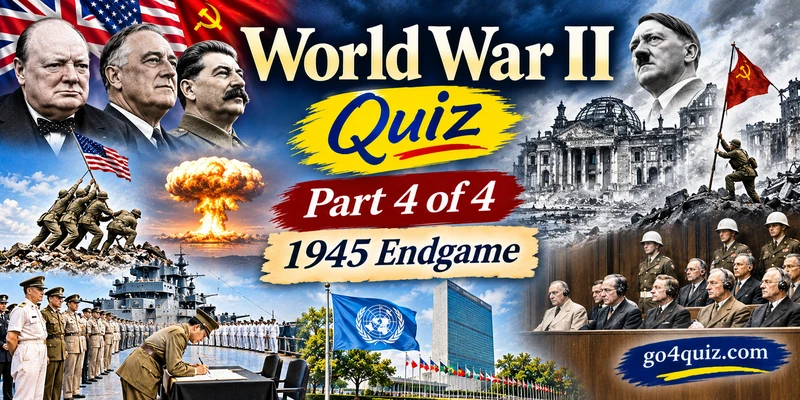
The year 1945 brought World War II to its dramatic conclusion and laid the foundations of the modern world. Part 4 of our chronological World War II quiz series opens in February 1945 at the Yalta Conference before following the brutal Pacific island battles on Iwo Jima and Okinawa, the Allied Rhine crossings, the death of President Franklin D. Roosevelt, and the final Soviet assault on Berlin leading to Adolf Hitler’s suicide and Victory in Europe on May 8, 1945. It then traces the Potsdam Conference, the atomic bombings of Hiroshima and Nagasaki, the Soviet entry into the war against Japan, Japan’s surrender and formal signing ceremony aboard USS Missouri, the founding of the United Nations, and the Nuremberg Trials. Test your knowledge of the climactic closing chapter of the conflict.
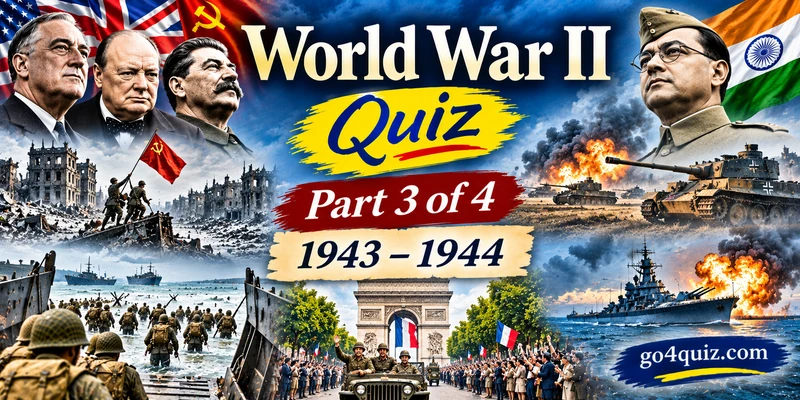
By early 1943, the Axis tide began to recede on every front as Allied industrial might and coordinated strategy shifted the initiative. Part 3 of our chronological World War II quiz series spans the pivotal years of 1943 and 1944, beginning with the German surrender at Stalingrad, the Casablanca Conference, the Warsaw Ghetto Uprising, and the epic armored clash at Kursk. It continues through the Allied invasion of Sicily and Italy, Subhash Chandra Bose’s leadership of the Indian National Army, the Tehran Conference of the Big Three, the Normandy D-Day landings of June 1944, Operation Bagration in Eastern Europe, the Liberation of Paris, the Battle of Leyte Gulf, and the winter Battle of the Bulge. Test your knowledge of the campaigns and leaders that broke Axis power.
In 1941 and 1942, regional conflicts across Europe, North Africa, and Asia fused into a truly global war. Part 2 of our chronological World War II quiz series follows the Lend-Lease Act, the Axis invasions of Yugoslavia and Greece, Rudolf Hess’s mysterious solo flight to Scotland, and Germany’s massive June 1941 invasion of the Soviet Union under Operation Barbarossa. It then traces the Atlantic Charter, the surprise Japanese attack on Pearl Harbor in December 1941, rapid Japanese conquests across Southeast Asia and the Pacific, and the pivotal 1942 turning-point battles at Coral Sea, Midway, Guadalcanal, and El Alamein. Test your command of the dates, operations, and leaders that defined the war’s critical middle years.

The years 1917 through 1919 brought the decisive upheavals that ended World War I and redrew the map of the world. Part 4 of our chronological World War I quiz series begins in early 1917 with Germany’s resumption of unrestricted submarine warfare, the intercepted Zimmermann Telegram, the Russian Revolution, and the entry of the United States into the war under President Woodrow Wilson in April 1917. It continues through the Canadian victory at Vimy Ridge, the Third Battle of Ypres (Passchendaele), the Battle of Cambrai, Russia’s exit in the Treaty of Brest-Litovsk, Germany’s 1918 Spring Offensives, the Allied Hundred Days Offensive, the Armistice of November 11, 1918, and the Treaty of Versailles in 1919. Test your grasp of the final campaigns and peace settlement that closed the Great War.

The year 1916 became synonymous with industrialized attrition and colossal battles across Europe, the Middle East, and the North Sea. Part 3 of our chronological World War I quiz series traces the key events of 1916, beginning with the final Allied evacuation of Gallipoli in January, Britain’s introduction of military conscription, and the opening of the grueling ten-month Battle of Verdun in February with Germany’s capture of Haumont and Fort Douaumont. It continues through the surrender of Kut al-Amara in Mesopotamia, the secret Sykes-Picot Agreement, the titanic naval clash at the Battle of Jutland, Russia’s sweeping Brusilov Offensive, the Arab Revolt, the Battle of the Somme and the combat debut of the tank, Romania’s entry into the war, and David Lloyd George becoming British Prime Minister in December 1916. Test your command of the battles, commanders, and turning points that defined 1916.

By 1915, hopes for a quick war had faded into entrenched stalemate on the Western Front, while fighting expanded dramatically across new fronts and oceans. Part 2 of our chronological World War I quiz series covers the events of 1915, including Germany’s February declaration of a submarine war zone, the first large-scale use of chlorine gas at the Second Battle of Ypres in April, the sinking of the ocean liner Lusitania in May, the Allied Gallipoli campaign against the Ottoman Empire, Italy’s entry on the Allied side in the Treaty of London, the Great Retreat of the Russian army, and Bulgaria joining the Central Powers in October. Test your knowledge of the turning points, weapons, and alliances that shaped 1915.