


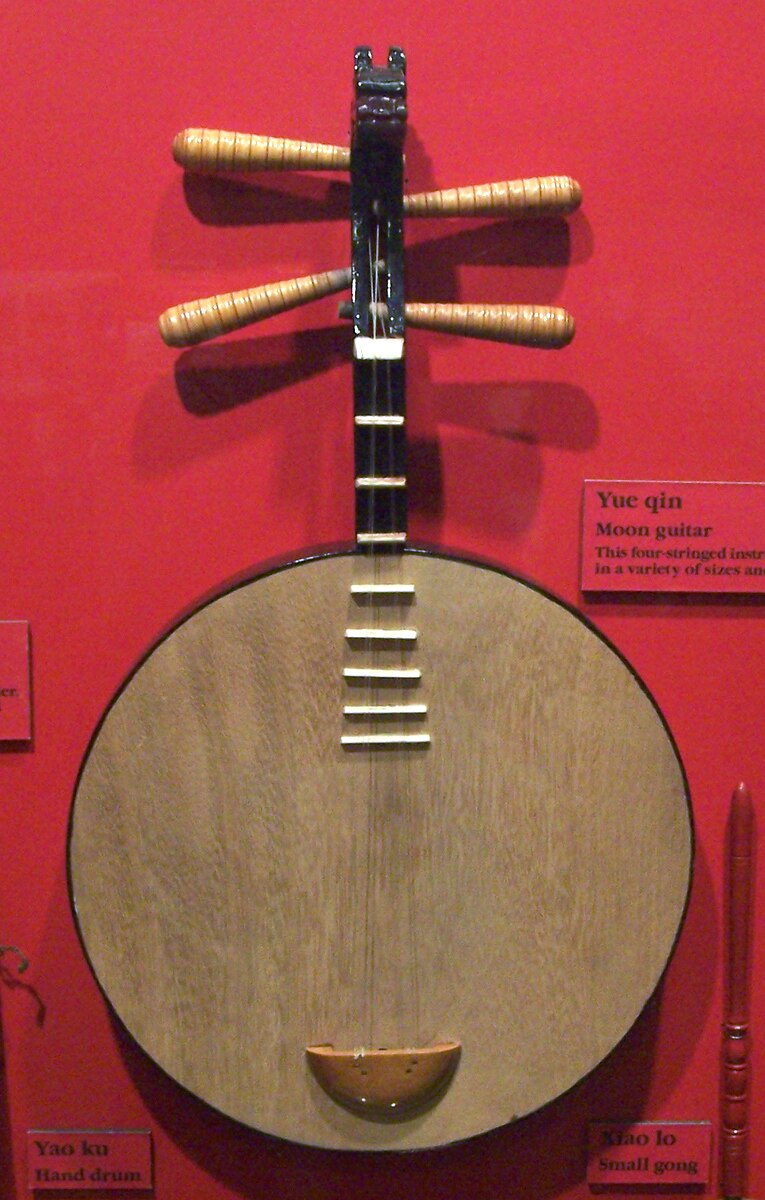
Q1. What is the primary reason the yueqin is nicknamed “moon guitar” or “moon lute”?
A. It is played primarily at night under moonlight
B. Its round body resembles the shape of a full moon
C. It was invented during a lunar festival
D. Its sound evokes the quiet of the night sky
Answer: B. Its round body resembles the shape of a full moon
Q2. The yueqin evolved from which ancient Chinese string instrument?
A. Pipa
B. Guzheng
C. Ruan
D. Erhu
Answer: C. Ruan
Q3. During which Chinese dynasty did the yueqin become known by its current name?
A. Tang Dynasty
B. Jin Dynasty
C. Han Dynasty
D. Qing Dynasty
Answer: A. Tang Dynasty
Q4. How many strings does a traditional yueqin typically have?
A. Three
B. Four
C. Five
D. Seven
Answer: B. Four
Q5. In traditional yueqin, the four strings are usually tuned in what manner?
A. All to different pitches
B. In consecutive semitones
C. In pairs, each pair tuned to the same pitch a fifth apart
D. As open fifths without courses
Answer: C. In pairs, each pair tuned to the same pitch a fifth apart
Q6. What is a common modern tuning for a four-string yueqin to allow doubling with ruan or liuqin?
A. A D A D
B. C G C G
C. E A E A
D. G D G D
Answer: D. G D G D
Q7. What material were yueqin strings traditionally made from?
A. Steel
B. Nylon
C. Silk
D. Gut
Answer: C. Silk
Q8. Which feature inside the yueqin body contributes to its distinctive buzzing timbre?
A. A fixed bridge
B. Loose wires or a metal plate that vibrates
C. Double sound holes
D. Movable frets
Answer: B. Loose wires or a metal plate that vibrates
Q9. Unlike Western fretted instruments, why are the frets on the yueqin raised high?
A. To make chord playing easier
B. To facilitate faster tuning
C. To increase volume
D. To allow fingers to avoid touching the body for better timbre control
Answer: D. To allow fingers to avoid touching the body for better timbre control
Q10. Modern yueqin frets are typically arranged in what scale?
A. Diatonic only
B. Pentatonic only
C. Chromatic semitones
D. Whole tones
Answer: C. Chromatic semitones
Q11. Occasionally, the yueqin body may have what alternative shape?
A. Square
B. Octagonal
C. Triangular
D. Heart-shaped
Answer: B. Octagonal
Q12. What wood is commonly used for the soundboard of a yueqin?
A. Paulownia (wu-tong)
B. Ebony
C. Rosewood
D. Mahogany
Answer: A. Paulownia (wu-tong)
Q13. How does the yueqin differ from the modern ruan in string attachment?
A. Yueqin uses a bridge; ruan attaches directly
B. Both use bridges
C. Yueqin attaches strings directly to the frame; ruan uses a bridge
D. Both attach directly
Answer: C. Yueqin attaches strings directly to the frame; ruan uses a bridge
Q14. In Peking opera (Beijing opera), what role does the yueqin often play?
A. Percussion leader
B. Main melodic instrument, sometimes replacing bowed strings
C. Bass accompaniment only
D. Wind section substitute
Answer: B. Main melodic instrument, sometimes replacing bowed strings
Q15. How many strings does the yueqin variant used in Peking opera typically have?
A. Two
B. Three
C. Four
D. Five
Answer: A. Two
Q16. In Peking opera yueqin playing, what is often used instead of a plectrum?
A. Fingers only
B. Nails
C. A small wooden dowel
D. A guitar pick
Answer: C. A small wooden dowel
Q17. The yueqin is classified under which Hornbostel-Sachs category?
A. Aerophone
B. Idiophone
C. Membranophone
D. Composite chordophone (necked box lute)
Answer: D. Composite chordophone (necked box lute)
Q18. Which instrument is the yueqin most similar to in East Asia outside China?
A. Vietnamese dan nguyet
B. Korean gayageum
C. Japanese koto
D. Mongolian morin khuur
Answer: A. Vietnamese dan nguyet
Q19. In modern uses, the yueqin has been adapted for which genres beyond traditional?
A. Only classical Chinese orchestra
B. Rock, pop, blues, and world fusion
C. Exclusively opera
D. Wind ensembles only
Answer: B. Rock, pop, blues, and world fusion
Q20. What distinguishes northern-style yueqin from southern variants?
A. Northern has longer neck; southern shorter
B. Northern uses five strings; southern four
C. Northern has very short neck and often bamboo components
D. Northern has visible sound holes; southern none
Answer: C. Northern has very short neck and often bamboo components
Q21. The yueqin is known for having the loudest volume among which group of instruments?
A. Chinese bowed strings
B. Chinese plucked lutes
C. Chinese winds
D. Chinese percussion
Answer: B. Chinese plucked lutes
Q22. How are yueqin strings typically plucked in modern playing?
A. With a bow
B. With mallets
C. Fingerstyle only
D. Using a plectrum or guitar pick
Answer: D. Using a plectrum or guitar pick
Q23. Compared to the pipa, the yueqin has what type of neck?
A. Longer and straighter
B. Shorter
C. No neck
D. Curved
Answer: B. Shorter
Q24. What allows greater pitch bending on traditional yueqin frets?
A. Low fret height
B. No frets
C. Movable frets
D. High fret height
Answer: D. High fret height
Q25. Which dynasty is credited with the invention of the yueqin as a distinct instrument?
A. Han
B. Tang
C. Jin
D. Song
Answer: C. Jin