

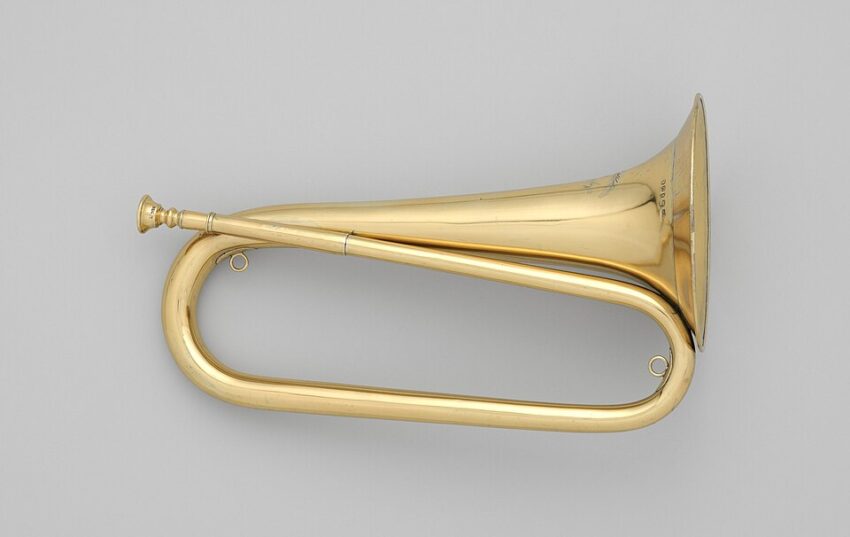
Q1. What family of musical instruments does the bugle belong to?
A. Woodwind
B. String
C. Brass
D. Percussion
Answer: C. Brass
Q2. How is pitch primarily controlled on a traditional bugle?
A. By pressing valves
B. By varying the player’s embouchure and airflow
C. By sliding a trombone-like slide
D. By covering holes like on a flute
Answer: B. By varying the player’s embouchure and airflow
Q3. The bugle is limited to notes in which musical series because it lacks valves?
A. Chromatic series
B. Harmonic series
C. Diatonic series
D. Pentatonic series
Answer: B. Harmonic series
Q4. What is the most common material used to make modern bugles?
A. Wood
B. Plastic
C. Brass
D. Silver
Answer: C. Brass
Q5. The word “bugle” derives from the Latin term meaning what?
A. Young bull
B. Hunting horn
C. Military signal
D. Flared bell
Answer: A. Young bull
Q6. Early bugles were often made from what natural material?
A. Bamboo
B. Animal horns
C. Ivory
D. Clay
Answer: B. Animal horns
Q7. In which century did the bugle become widely used as a modern military signaling instrument?
A. 16th century
B. 17th century
C. 18th century
D. 19th century
Answer: C. 18th century
Q8. The bugle differs from the trumpet mainly in its bore shape, which is:
A. Cylindrical throughout
B. Conical throughout
C. Narrow with a small bell
D. Identical to the trumpet
Answer: B. Conical throughout
Q9. Which famous bugle call signals the start of the duty day and wake-up in military settings?
A. Taps
B. Retreat
C. Reveille
D. Assembly
Answer: C. Reveille
Q10. Which bugle call is played at military funerals and signals “lights out”?
A. Reveille
B. Mess
C. First Call
D. Taps
Answer: D. Taps
Q11. What is the typical key of a standard military bugle?
A. C
B. B-flat
C. F
D. E-flat
Answer: B. B-flat
Q12. How many basic notes are commonly used in most bugle calls (from the 2nd to 6th harmonics)?
A. 3
B. 4
C. 5
D. 12
Answer: C. 5
Q13. The keyed bugle, invented in the early 19th century, added what feature to allow more notes?
A. Valves
B. Keys
C. A slide
D. A double bell
Answer: B. Keys
Q14. Who patented the Royal Kent bugle, a popular keyed version?
A. Joseph Halliday
B. Adolphe Sax
C. Theobald Boehm
D. Harry Pedler
Answer: A. Joseph Halliday
Q15. In Boy Scouts, the bugle is often used for which purpose?
A. Orchestral performances
B. Jazz improvisation
C. Signaling daily camp routines like Reveille and Taps
D. Accompanying bagpipes
Answer: C. Signaling daily camp routines like Reveille and Taps
Q16. Cavalry units historically preferred which instrument over the standard bugle for close-range signals?
A. Drum
B. Trumpet
C. Fife
D. Flute
Answer: B. Trumpet
Q17. The bugle’s flared bell helps primarily with what?
A. Reducing volume
B. Changing pitch
C. Projecting sound over distance
D. Adding valves
Answer: C. Projecting sound over distance
Q18. Which instrument evolved from the bugle and added piston valves in the 1820s?
A. Trombone
B. Cornet
C. Tuba
D. Flugelhorn
Answer: D. Flugelhorn
Q19. A common Boy Scout bugle model is based on the U.S. Army specification from which year?
A. 1798
B. 1892
C. 1917
D. 1945
Answer: B. 1892
Q20. What is the primary modern use of the bugle?
A. Ceremonial and military signaling
B. Orchestral solos
C. Jazz bands
D. Rock music
Answer: A. Ceremonial and military signaling
Q21. The fundamental note on a bugle is rarely used because it is:
A. Too high
B. Difficult to produce reliably
C. Chromatic
D. Valved
Answer: B. Difficult to produce reliably
Q22. Which bugle call warns soldiers to prepare for formation?
A. Mess
B. Retreat
C. First Call
D. Church
Answer: C. First Call
Q23. The bugle was adopted by Hanoverian light infantry from which earlier horn?
A. French horn
B. Shofar
C. Post horn
D. Hunting horn (semicircular copper horn)
Answer: D. Hunting horn (semicircular copper horn)
Q24. In drum and bugle corps, modern bugles often include how many valves?
A. None
B. One
C. Two or three
D. Four
Answer: C. Two or three
Q25. Which composer featured bugle-like motifs in works such as the Military Symphony?
A. Beethoven
B. Haydn
C. Mozart
D. All of the above
Answer: D. All of the above